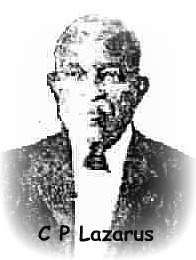
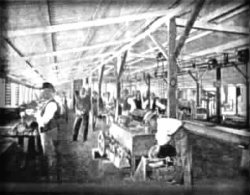
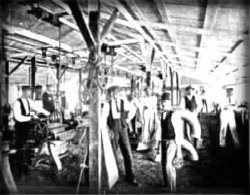
At five he went to the Wesleyan school, then later to the Roman Catholic School at Sutton Street. Afterwards he was a Wolmer’s boy. He left school at 13 and had to begin work at once. He was indentured to learn the trade of a plumber in December 1849. At nineteen he started his own business, establishing his famous foundry in West Kingston in 1855. For over 60 years the West End Foundry was constantly employed in important work, especially for the sugar estates, and through it passed more than one thousand young men whom he trained.
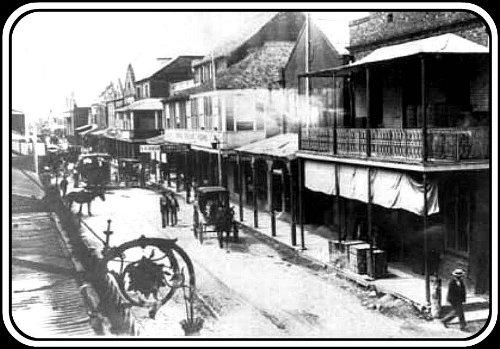
In 1870, when the ocean telegraph cable was being laid, Lazarus assisted with the operations and was recognised for the high quality of his work. The following year he cast a monster water-wheel for Savoy Estate in Clarendon. The Governor, Sir John Peter Grant, was among those who paid a special visit to the Foundry when the great wheel was completed to see it before it was dispatched to its destination. After the terrible fire which destroyed the commercial area of Kingston in December 1882, Lazarus was one of the most prominent builders involved in the reconstruction of the city. An important Kingston building which he constructed was the synagogue on Duke Street, in 1888 (the present building is that reconstructed after the 1907 earthquake.)
Lazarus involved himself in various public activities, including service on the Kingston City Council, and was made a J P near the end of his life. Robert Love recognised his stature as a public figure and worked with him throughout his career.
When he died in 1917, ‘Tom Redcam’, then editor of the Jamaica Times wrote of him: ‘Charles P. Lazarus was a personality of strong and distinctive character, cast in some respects on antique lines, which recalled at times a combination of the Roman and Puritan outlook on life. He was an original and stimulating thinker, possessing great powers of reflection, a luminous native wit and a large store of sound practical wisdom. With the spirit of thoroughness and efficiency he was imbued through and through, and his unerring instinct for essentials was a remarkable trait.’
Interestingly, one can see an example of Lazarus’ work any day, by travelling up Hope Road from Half-Way-Tree: it was Charles Philip Lazarus who built George Stiebel’s famous Devon House.
Two views of C. P. Lazarus' foundry.